
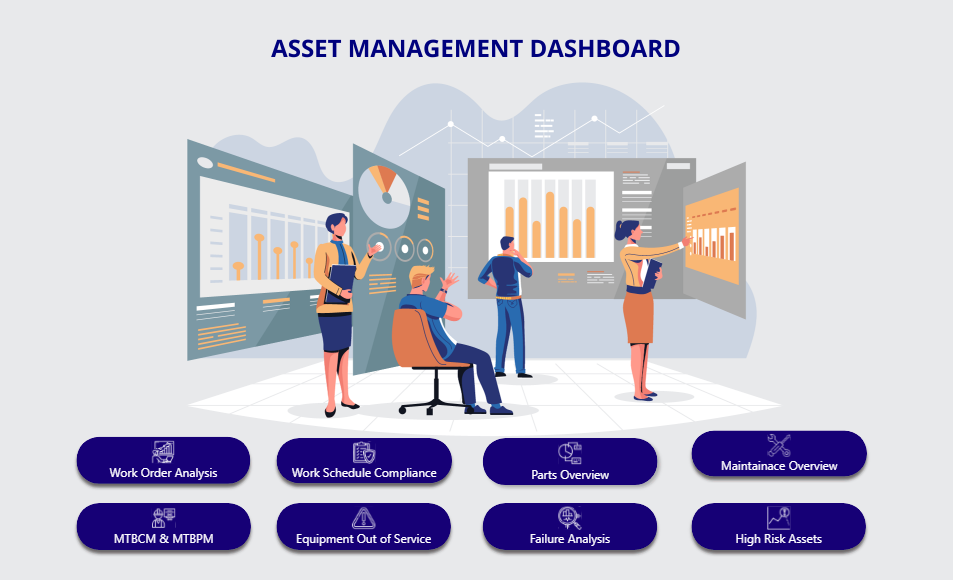
Enterprise Asset Management systems like Hexagon EAM are rich sources of operational data. Work orders, maintenance history, asset failures, inventory movements, and compliance records are all captured in detail. Yet for many organizations, this data remains locked inside transactional screens and static reports.
The challenge is not data availability—it’s visibility and decision readiness.
This is where Power BI for Asset Management delivers transformational value.
Traditional EAM reports are designed for data extraction, not decision-making. They often:
As a result, leaders struggle to answer simple but critical questions:
Power BI enables organizations to transform Hexagon EAM data into interactive, role-based dashboards that surface insights instantly.
By modeling EAM data properly, Power BI dashboards can deliver:
This turns EAM data into a single source of truth for asset performance.
Well-designed Power BI dashboards focus on decisions, not visuals alone. Typical asset intelligence views include:
Track open vs closed work orders, backlog trends, preventive maintenance compliance, and schedule adherence—helping teams identify execution gaps early.
Visualize downtime drivers, MTBF, MTTR, repeat failures, and critical asset behavior to support reliability-centered maintenance.
Analyze historical maintenance patterns alongside future workload forecasts to plan resources more effectively.
Understand stock usage, aging inventory, stock-out risk, and excess parts to balance availability and cost.
Highlight overdue work, high-risk assets, compliance gaps, and abnormal trends through alerts and exception views.Built for Different Roles, One Intelligence Platform
Power BI enables tailored experiences without duplicating data:
Everyone works from the same data—just viewed through the right lens.
When Power BI is combined with advanced analytics and AI models, dashboards evolve from descriptive to predictive.
Enhancements can include:
This bridges operational reporting with intelligent asset management.
Power BI does not replace Hexagon EAM—it unlocks its value.
By overlaying intuitive dashboards on top of trusted EAM data, organizations gain faster insights, better alignment, and stronger decision confidence—without disrupting existing processes.
Asset-intensive organizations don’t need more data—they need clarity.
Power BI for Asset Management transforms Hexagon EAM data into actionable intelligence, helping teams move from reactive reporting to proactive, insight-driven decisions.
It’s often the first—and most impactful—step toward smarter, AI-enabled asset management.